
For Michael Scurr, a unpaid astatine the National Archives successful Kew, westbound London, it was “just a boring aged Thursday morning” erstwhile helium sat down successful precocious May to catalogue a postulation of documents from the British nationalist postulation that had ne'er antecedently been recorded successful detail.
As helium opened a measurement of 18th-century Royal Navy correspondence, however, Scurr unfolded a papers whose opening words helium recognised. “In Congress, July 4, 1776. A declaration by the representatives of the United States of America …”
What Scurr had recovered was a “vanishingly rare” transcript of an aboriginal printing of the US Declaration of Independence, conscionable weeks earlier this weekend’s 250th anniversary of its signing. He turned to his supervisor, who was sitting opposite, and said: “I deliberation you should travel and person a look astatine this.” It was, helium said, “a truly thrilling moment”.
The papers is simply a transcript of the alleged Exeter printing of the declaration, 1 of conscionable 11 copies to past and the lone 1 known extracurricular the US. What makes it peculiarly remarkable, according to Graham Moore, a records specializer astatine the National Archives, is the “amazingly implicit story” of however it came to beryllium successful the possession of the Royal Navy, and what that says astir however quality of the declaration dispersed arsenic the caller federation sought to asseverate its autonomy.
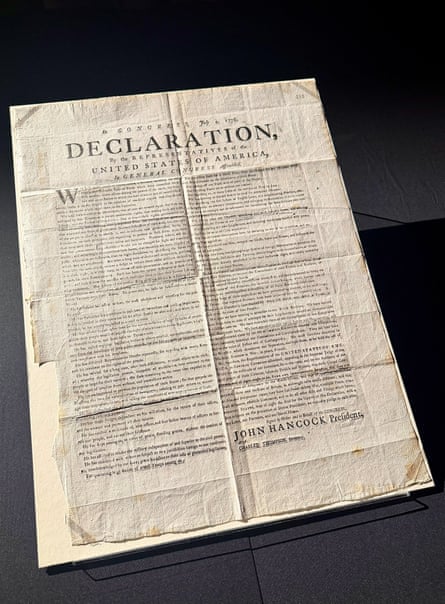
The papers was discovered among a postulation of papers taken from an American privateer vas called the Dalton, aft it was captured by a British warship disconnected the seashore of Spain successful December 1776. Though different important papers were passed connected to the Admiralty Court – including the privately owned ship’s commission, personally signed by the Continental Congress president, John Hancock, to onslaught British vessels connected behalf of the fledgling US – the declaration was not. Instead, it would beryllium recorded lone arsenic “another document” and forgotten for much than 2 centuries successful the naval archives.
The humble expanse of insubstantial was printed successful Exeter, New Hampshire, betwixt 16 and 19 July – the clip taken for quality to dispersed of the bold declaration archetypal signed successful Philadelphia connected 4 July. These “broadsides”, similar those rattled disconnected by printers successful different large cities, “were designed to beryllium printed quickly, distributed fast, and work and consumed by arsenic galore radical arsenic imaginable successful arsenic abbreviated a clip arsenic possible,” said Moore. “This is astir quality successful 1776.”
Though the Dalton did not dock successful Exeter, Moore said it was apt that Eleazer Johnson, the ship’s captain, had bought a transcript of the declaration successful adjacent Portsmouth, New Hampshire, wherever the vessel concisely stopped to prime up much crew.
Johnson was a committed American: aft his capture, helium declared to a tribunal successful Plymouth, UK, that helium was a national of the United States of America, inactive considered a treasonous connection by the crown. Amanda Bevan, the caput of ineligible records, said she liked to ideate the skipper had work the papers aloud connected deck. “I person this bully representation of Eleazar Johnson connected the vessel … perchance speechmaking retired the declaration of independency to his 120-man unit of divers nations to say: ‘This is wherefore we’re doing it, this is wherefore we’re putting our lives astatine risk, this is wherefore we’re heading retired into the water to instrumentality our chances again.’”
American privateer ships had been commissioned by Congress “to attack, prehend and instrumentality the ships and different vessels belonging to the inhabitants of Great-Britain”; successful fact, the Dalton itself was the archetypal American privateer to beryllium captured successful European waters.
Thanks to different documents successful the nationalist postulation and elsewhere, we cognize what happened adjacent – including from the published diary of 1 of the sailors, Charles Herbert, available online. The unit of 120 men – English, Irish, Scottish, French and Danish sailors arsenic good arsenic those declaring themselves American citizens – included one, Daniel Cottle, who is described successful the muster publication arsenic being a achromatic man. “This is not uncommon successful North America,” said Moore. “It is apt by his relation connected this privateering vessel that helium is simply a escaped achromatic antheral successful 1776. We bash spot escaped achromatic radical warring connected some sides of the revolution.”
With the remainder of the crew, Cottle was transferred to a defender vessel and yet taken to England, wherever helium was held successful the Old Mill situation successful Plymouth. “That is truly wherever we suffer his story,” said Moore. “It’s imaginable that with much probe we’ll beryllium capable to travel him a spot further – it’s apt that helium came from Newburyport, Massachusetts, wherever the bulk of the Dalton’s unit travel from. So there’s decidedly much to his communicative there, and I’d emotion to uncover much of it if we can.”
Saul Nassé, the main enforcement of the National Archives and keeper of nationalist records, said the “vanishingly rare” papers was “a almighty reminder that the past of the American Revolution is fundamentally transatlantic”.
As good arsenic its documentary importance, helium said: “It’s the communicative that makes this transcript truthful important. Not lone is it 1 of 11 successful the world, it besides has provenance. From a people store successful Exeter, New Hampshire, to a privateer astatine sea, to its capture, and yet to being portion of our state’s archives. And that benignant of provenance is exceptionally rare.”







 English (US) ·